Fall 2023 and Spring 2024
I started indoor climbing in my first semester of college. I went an average of 1-2 times a week in my freshman year, for a total of 25 days in my first semester and 12 days in my second semester. I bought climbing shoes after 11 sessions.
During that entire year, I stayed at the V0-V2 level. While I could blame my lack of strength and my height, I think the main problem was simply that I didn't push myself to do V3 climbs.
I have a completionist attitude about finishing all the climbs in a grade first. But I didn't go often enough to finish all the V0-V2 climbs in the gym, so I stayed at that level.
Takeaway: Go climbing more often.
Summer 2024
In the summer, I continued climbing. We went an average of 2 times a week, for a total of 21 days.
One of my friends broke through V1 in his first session, V2 in the second session, V3 in the third session, and V4 in the fourth session. We joked that he had linear growth. Climbing with him really pushed me to try harder grades, and I broke through V3 at the same time that summer.
Takeaway: Collaboration can help you break through plateaus. Watch and talk to people!
Fall 2024
In my first semester of sophomore year, I climbed on a total of 26 days. But I was stuck in the V2-V3 range and felt frequently frustrated with the wall.
One of the things that I didn't know at the time was that rest is not the same as recovery. As a beginner, a day of rest is probably enough to be fully recovered. But when you put more stress on your body, it might take days of rest or "active recovery" before you are fully recovered. And on those recovery days, you won't be able to quite perform at your best. This just happens naturally from the cycle of stress and recovery.
Because my mantra was just to try harder, that semester I:
- Sprained my ankle from falling badly off a wall
- Pulled a back muscle from attempting an overhang problem too many times
- Cried frustrated tears after falling off a V2 I "should" be able to do
I didn't climb for a week after the sprained ankle. I also had to stop climbing for a semester to let my back recover.
Takeaway: Listen to your body. Don't put too much stress in a particular muscle in one session by attempting a problem over and over again.
Summer 2025
I started climbing again after a semester off. I could climb around half of the V3s and some of the soft V4s in the gym. The goal I gave myself was to send one new V3 every session and one new V4 every week. I think it motivated me to keep trying on my projects. My strengths are slabs and crimps, but I struggled on dynos, overhangs, roofs, and long routes that required more strength and stamina.
I also started going to the gym to get stronger. It was a bit difficult balancing gym with climbing—If I wasn't careful about how hard I pushed myself in the gym, I could accidentally put myself out of commission (for climbing) for 1-2 days.
Takeaway: Other aspects of your life will invariably affect your climbing progression. It's important to eat well, sleep well, and not be chronically stressed.
Fall 2025
I found a really nice group of friends to climb with this semester. I think that really motivated me to go more often, which helped a lot with my climbing. I climbed on a total of 43 days this semester, and I sent my first V5!
Toward the end of the semester, I would often end a session without sending anything new. Perhaps it's a sign of a plateau. I think I should focus a little more on volume and do less projecting. My weaknesses are still dynos, body tension, and slopers.
I also started recording my climbs! I don't feel that they're that helpful for analyzing technique, but it's nice to have a reminder of some of the climbs I've done.
I tried maintaining my gym routine, but I became too busy with schoolwork, and it interfered with my climbing schedule.
Takeaway: Climb with friends! You will climb more often!
Winter 2025
I started climbing at Benchmark Climbing in Berkeley, CA. Benchmark Climing has a very different style than Rock Spot Providence; its ceiling is lower, so the routes are shorter. The holds are also granier and better. I felt like my hands and feet stuck very well on every hold. Because of that reason, I started using more strength on every climb; e.g. locking and pulling with force.
I also did more dynos!
Takeaway: gyms have very different styles and types of holds!
Spring 2026
Did more jumps! Broke into v5! Didn't get hurt!
Takeaway: Just keep climbing.
Summer 2026
I started climbing at Austin Bouldering Project (ABP) this summer. ABP is a very beginner-friendly gym; most of the holds are pretty juggy, and even the easy climbs are pretty interesting.
ABP is also a very big gym that changes its routes often, so you never run out of new things to try. It's also the first gym I've been in that has a cave section.
I also learned a lot about how to do vertical jumps correctly. You kind of want to spring up and "float" in the air.
I also made a lot of friends at Cloudflare by introducing them to climbing! It was awesome showing them beta and watcing them get better at climbing. All my love to y'all.
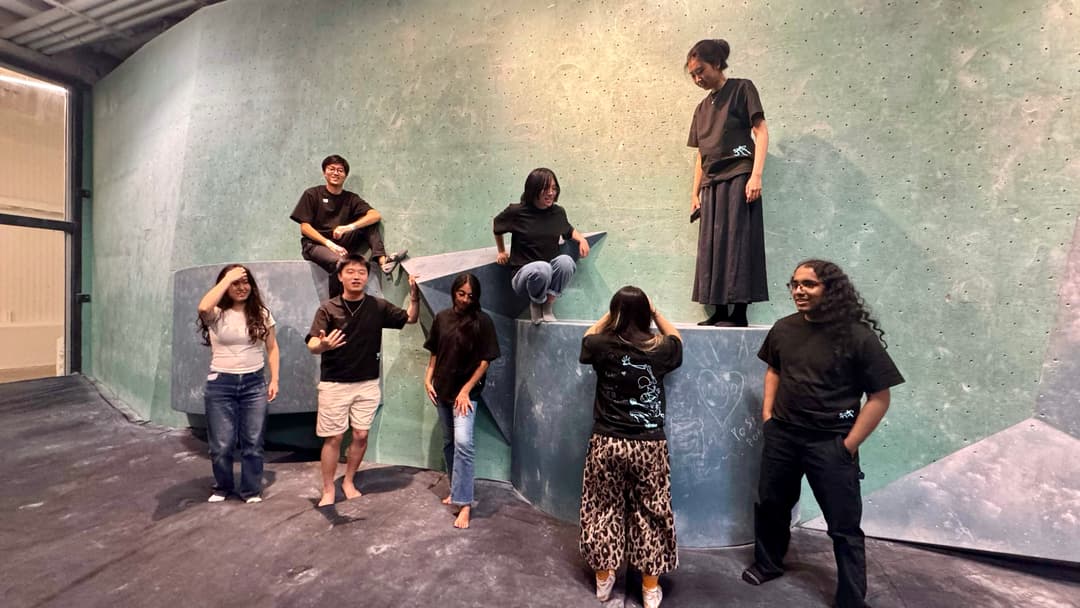
Takeaways: the most important part of climbing is: believe!
Appendix
My progress has looked like this so far:
| Season | # Climbing Days | Project Grade |
|---|---|---|
| Fall 2023 | 25 | V2 |
| Spring 2024 | 12 | V2 |
| Summer 2024 | 21 | V2 |
| Fall 2024 | 26 | V3 |
| Spring 2025 | 1 | V3 |
| Summer 2025 | 24 | V3 |
| Fall 2025 | 43 | V4 |
| Spring 2026 | 49 | V4 |
| Summer 2026 | 30 | V5 |
Some general thoughts I have:
-
Technique is mainly about getting the right body position and footwork to maintain tension while minimizing the amount of force put on the hands and the fingers. In other words: "legs strong, arms weak." This is a great video on the topic: Learn 100+ Climbing Techniques With Just 4 Movement Concepts.
-
Always focus on technique. Never try to muscle through anything. If you get a problem by muscling through it, come back later and do it with better technique.
-
But if you come into climbing without a lot of strength, it really does help to go to the gym. Being stronger will let you spend more time on the wall, which will let you get better technique.
-
Try to spend at least 2-3 sessions on volume and 0-1 sessions on projects per week. Building up a base is more important than trying to send a specific hard problem. Repeating a hard problem over and over again can also increase risk of injury.
-
If you're a short climber, there will be some problems that are much easier for taller climbers. For example, I have a friend who is stronger and taller than me, but a weaker climber. The set of V3s I can do and the set of V3s he can do is completely disjoint. That's completely okay!
I was inspired to write this after reading Steven's 7.5 year self assessment of climbing, strength training, and hangboard.